

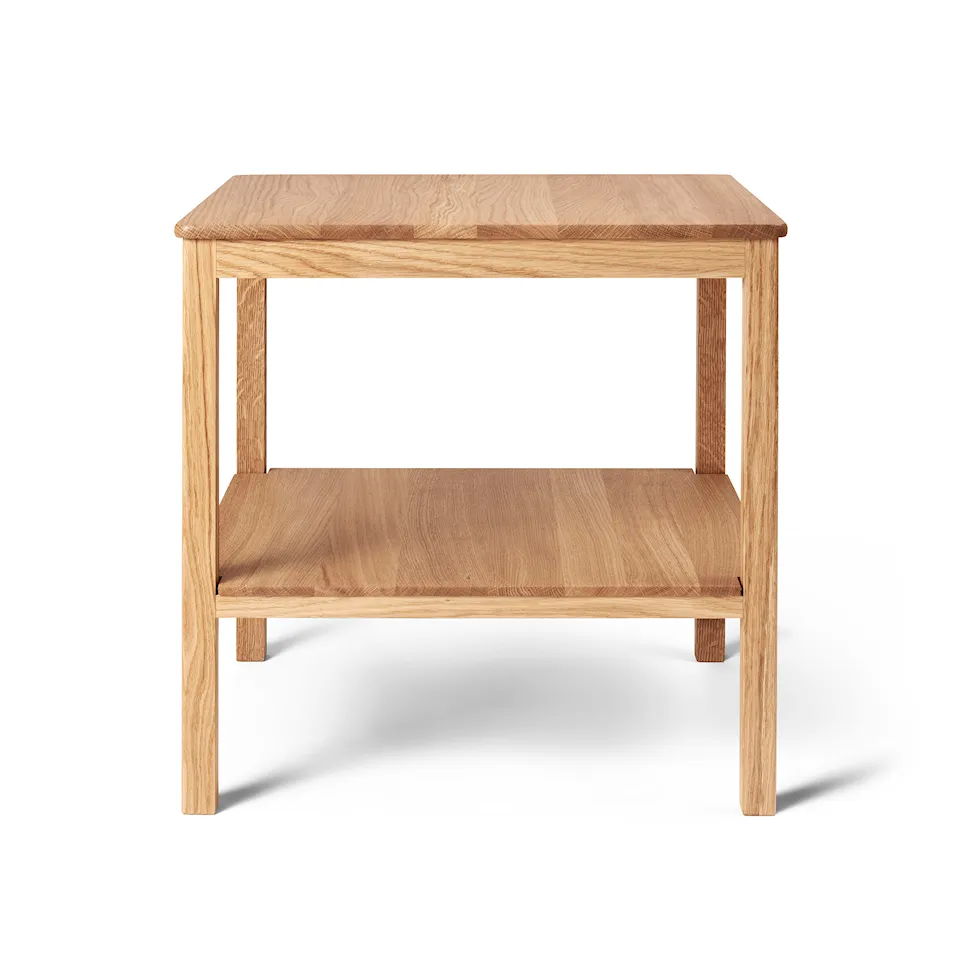
Kaare Klint small tables
Kaare Klint is a prominent name in Scandinavian design history. Born in 1888 in Frederiksberg as the son of architect P.V. Jensen-Klint, he grew up in an environment shaped by architecture, art, and craftsmanship. This background laid the foundation for an approach where furniture should always be based on proportion, function, and usability.
1 products

Kaare Klint 1888-1954
Kaare Klint’s furniture is characterized by a pared-down design language in which proportions, materials, and function are always in harmony. His first major commission was the interior design of the Faaborg Museum in 1914, where he introduced the Faaborg Chair – a chair that combined lightness, material awareness, and proportional precision. In the 1930s he created the Safari Chair, inspired by British officers’ furniture but refined with a simplicity that makes it timeless. The chair was delivered flat-packed and is considered one of the first pieces of self-assembly furniture. Many of Klint’s works are produced today by Carl Hansen, and are among his most recognized works and established design classics. These pieces clearly demonstrate how Klint merged historical references with modern functionality.
Minimalist design with historical grounding
Klint often drew inspiration from historical furniture types but analyzed their measurements and construction to translate them into a modern lifestyle. This methodical process resulted in pieces such as the Safari Chair and the Propeller Stool – designs that still feel contemporary in both expression and function.
The furniture reflects uncompromising craftsmanship and a thoughtful design language. Materials such as solid wood, leather, and natural fibers are crafted with precision, resulting in furniture that works equally well in everyday use and prestigious settings. His works can be found today in both museums and private homes, appreciated for their balance of functionality and beauty.
Teacher and architect
In addition to his role as a designer, Kaare Klint played a significant role as a teacher. In 1924 he founded the furniture school at the Royal Danish Academy of Fine Arts in Copenhagen, where he became professor. There he educated several of the most influential designers of the 20th century, including Arne Jacobsen, Børge Mogensen, Mogens Koch, Poul Kjærholm, and Hans J. Wegner. Through this teaching, he laid the foundation for what would come to define Danish design: simplicity, function, and a consistent focus on the properties of materials.
Klint also worked on architectural projects. He redesigned the Thorvaldsens Museum in 1923 and, after his father’s death, completed the work on the Grundtvig’s Church in Copenhagen, which was finished in 1940. From this project came the Church Chair – a chair that clearly demonstrates his focus on function and proportion.
He was also active in the family business Le Klint, known for its pleated paper lampshades.
During his career, Klint received several honors, including the Eckersberg Medal in 1928, the C.F. Hansen Medal in 1954, and the honorary title Royal Designer for Industry in London in 1949.
Is there something you are missing in terms of kaare klint?
Please contact us via our contact form to discuss your specific product request.